Why Hospital Staff in Bangladesh Waste 2 Hours Every Day
Hospital staff in Bangladesh often lose 90–120 minutes per shift searching through PDF documents, treatment protocols, drug references, lab manuals, and procedure guides. The problem is not that hospitals lack knowledge. The problem is that the knowledge is trapped inside scattered documents that staff cannot search quickly during real work. AI document Q&A — a system that lets users ask questions in plain language and receive cited answers from uploaded documents — fixes this by turning hospital PDFs into searchable, verifiable knowledge. Instead of opening folders, scanning long files, and guessing which PDF contains the answer, staff can ask one question and get the relevant answer in seconds with the source citation attached.
What Is the Scene Every Hospital Manager Recognizes?
It is 9:30 in the morning. The hospital floor is already busy. A nurse needs to confirm a treatment protocol before preparing a patient for the next step. The information exists somewhere. It may be in a PDF, a printed handbook, a shared Google Drive folder, a local computer, or a file sent months ago in a WhatsApp group.
The nurse searches the folder. The file names are not consistent. One document says “Protocol_Final.pdf.” Another says “Updated_Guideline_2024.pdf.” A third one has the department name but no clear topic. The nurse opens one file, uses Ctrl+F, tries three keywords, finds nothing useful, closes it, and opens another.
This is not laziness. This is a system design problem.
In many Bangladeshi hospitals, diagnostic centers, and clinics, staff already know how to work hard. The issue is that document knowledge has grown faster than the search systems around it. Treatment protocols, lab reference guides, compliance documents, drug references, training materials, and internal SOPs keep increasing. But staff are still expected to find answers manually.
A 10-minute search repeated many times across a shift becomes 90–120 minutes lost every day. Across departments, the loss becomes expensive.
What Is the Real Cost of Hospital Document Search?
Manual document search feels small because it happens in pieces. Five minutes here. Ten minutes there. One staff member asking another. One manager forwarding an old PDF again. But the annual cost becomes visible when you calculate it.
Cost of Manual Hospital Document Search
5 staff × 90 minutes/day × ৳500/hour × 250 working days
90 minutes = 1.5 hours
5 × 1.5 × ৳500 × 250
= ৳9,37,500 per year
Even at a conservative department-level estimate: ৳1,56,250+ per year can disappear in repeated document search time.
The exact number changes by hospital size, salary structure, and department workload. But the operational pattern is the same: staff are paid to deliver care, manage patients, coordinate procedures, and support doctors. They should not be spending large parts of their day hunting through PDFs.
Now multiply the problem across emergency, pharmacy, nursing, pathology, administration, HR, billing support, and compliance. What looked like a small daily inconvenience becomes a recurring productivity leak.
And the cost is not only salary. Slow document search creates delayed decisions, repeated questions, inconsistent answers, and unnecessary dependency on senior staff.
Why Does Keyword Search Not Solve This?
Keyword search helps only when the user knows the exact word used inside the document. Hospitals do not work that way. A staff member may search for “child fever protocol,” while the PDF uses “pediatric pyrexia management.” Someone may search “drug reaction,” while the document says “adverse medication response.”
Traditional search matches words. Hospital work needs meaning.
Comparison Table:
Criteria | Keyword Search | AI Document Q&A |
|---|---|---|
Speed | Slow when documents are large or scattered | Finds meaning, not only exact words |
Citation | Usually shows a page or file only | Shows the exact source used for the answer |
Keyword search returns documents. AI document Q&A returns answers with sources.
That difference matters. In healthcare, staff do not only need “some file.” They need the correct answer, from the correct protocol, with enough traceability to verify it.
What Does AI Document Q&A Actually Do?
AI document Q&A is not a generic chatbot guessing from the internet. In a proper hospital deployment, the system answers from the hospital’s own uploaded documents.
At BYV, this approach is built through the Enterprise RAG development service — Retrieval-Augmented Generation, an AI architecture that retrieves relevant information from your own documents before generating an answer. The purpose is simple, the AI should not invent answers. It should find the right source, answer from that source, and show where the answer came from.
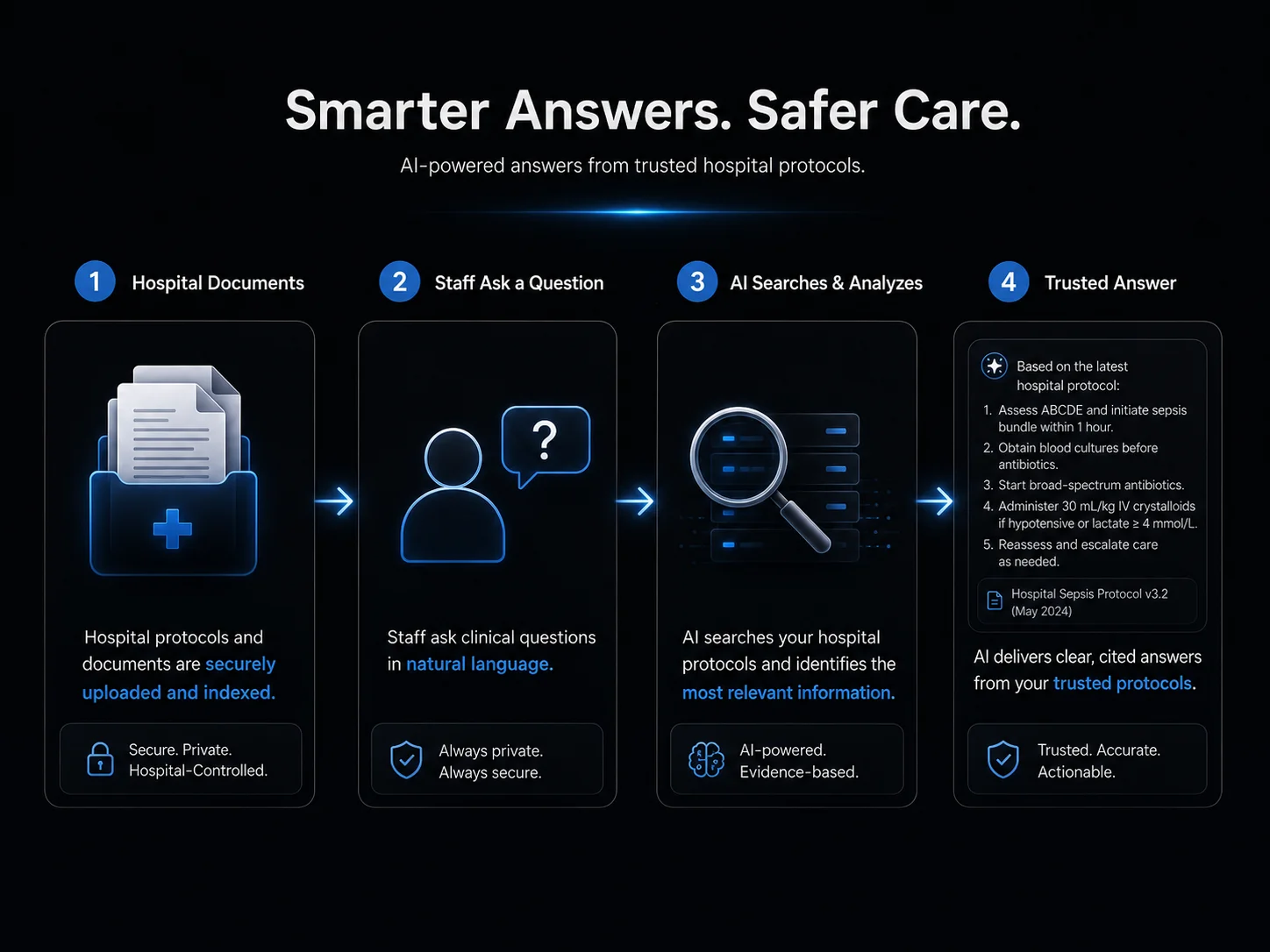
For example, a staff member could ask:
“What is the protocol for preparing a patient before this lab test?”
The system searches the uploaded hospital documents, finds the most relevant section, and returns a direct answer with a citation. The staff member can verify the source immediately.
This is where DocsQA fits into BYV’s ecosystem. DocsQA is our ready-made document Q&A product built for healthcare organizations. It lets hospitals upload PDF, DOCX, or TXT files and ask questions in plain language. For hospitals that need deeper customization, integration with an existing hospital management system, or on-premise deployment, BYV builds the custom AI layer around it.
How Are Hospitals in Bangladesh Using This Today?
The most practical use cases are not futuristic. They are everyday hospital workflows.
Treatment protocols: Staff can ask about preparation steps, escalation rules, or department-specific procedures without opening long PDFs manually.
Drug references: A pharmacy or nursing team can search approved internal drug reference documents faster, while still verifying the cited source.
Lab manuals: Diagnostic teams can ask about sample collection rules, reference ranges, or test preparation instructions.
Staff training materials: New employees can ask questions about internal SOPs instead of repeatedly asking senior staff.
Compliance documents: Admin and operations teams can retrieve policy details from internal documents without scanning hundreds of pages.
The goal is not to replace doctors, nurses, or hospital managers. The goal is to remove the document-search burden from people who already have important work to do.
A good AI system for hospitals must be narrow, grounded, and auditable. It should answer only from approved documents. It should show citations. And when the answer is not available, it should say that clearly instead of guessing.
That is the difference between a useful healthcare AI tool and a risky chatbot.
Frequently Asked Questions
How long does setup take?
Basic DocsQA setup takes under 30 minutes. A hospital can upload documents, index them, and start asking questions from those files. Larger deployments with multiple departments, role-based access, and custom integrations may take longer.
Is patient data secure?
Yes, a secure deployment can be designed so documents and sensitive data stay inside the hospital’s controlled environment. For hospitals with strict data requirements, BYV can build an on-premise or private-cloud deployment with proper access control and isolation.
Does it work with Bangla documents?
DocsQA currently works best with English documents. Bangla document support is on the active roadmap, and BYV can evaluate Bangla-heavy document sets during a technical consultation to recommend the right approach.
What documents can it process?
DocsQA supports PDF, DOCX, and TXT files. For custom BYV deployments, hospital knowledge can also be connected to internal databases, existing systems, and structured records depending on the project scope.
What happens if the answer is not in the document?
A proper AI document Q&A system should not guess. If DocsQA cannot find relevant information in the uploaded documents, it returns a “not found” style answer instead of inventing medical guidance.
Is AI document Q&A the same as ChatGPT?
No. ChatGPT usually answers from general model knowledge. AI document Q&A for hospitals uses Retrieval-Augmented Generation, meaning it retrieves information from the hospital’s own documents and generates an answer grounded in those sources.
Can multiple hospital staff use it at the same time?
Yes. DocsQA is built as a production system with multi-user usage in mind. For larger hospitals, BYV can design the deployment around expected staff volume, department-level access, and performance requirements.
Try DocsQA free — upload your first hospital document today
Hospital staff should not lose 2 hours every day searching through PDFs. Start with one protocol document, ask real questions, and see how fast cited document answers can change daily operations.
DocsQA is our ready-made document Q&A product for healthcare organizations. Try DocsQA Free
Need a custom hospital deployment? Book a free 30-minute BYV consultation
Comments (0)